


by John Rosso
It makes no difference how good your research is, what AI tool you’re using, how well you’ve mapped out the opportunity, or what your LinkedIn profile connects to or could connect you to. The hard reality is, nobody wakes up in the morning dying to buy your product or service, and hoping you would reach out to them to talk about it.
What gets people moving—what drives urgency, engagement, and real decisions—is what David Sandler always said motivated action: pain.
Sandler wasn’t talking about physical pain, of course. He meant the kind of emotional distance between where someone is right now and where they know they ought to be. He meant the pressure cooker of frustration and unmet expectations that makes people think, or say right out loud, “Something’s got to change” – or any variation on that sentiment. Your job is to find that pain, connect to it, get people talking about it, and get them to stay in it longer than feels comfortable—because that’s where the sale lives. Pain is a blessing. It is a signal to take action.
Pain Overrides Pleasure
Daniel Kahneman is a widely recognized behavioral economist; he received the 2002 Nobel Prize in Economic Sciences for integrating insights from psychological research into economic science, particularly concerning human judgment and decision-making under uncertainty. Kahneman has confirmed definitively something David Sandler taught me long ago, namely that loss aversion—the idea that people will go further to avoid pain than they will to gain something—is a hardwired human trait. We will do twice as much to avoid a loss as we will to chase a win. That’s just built into the species. So why are so many salespeople still leading with features, benefits, and best-case scenarios?
When you talk about sunshine and rainbows before I even feel the rain, you lose my emotional engagement. That’s because you’re skipping the very thing that makes me want to move: pain. If there’s no pain, specific to my world, then there’s no urgency on my part. If there’s no urgency, you cannot count on me signing off on any deal.
Pain is the Bond
Emotional pain, specific to the individual, isn’t just a motivator—it’s a bonding agent. When someone shares their pain with you, they’re not just giving you intel. They’re handing you trust and being vulnerable.
No matter how good our technology is, the core truth remains: if we get good enough at helping people discover and articulate their pain, we don’t have to sell them anything. We can just guide them toward relief. That’s the shift—from pushing products to pulling prospects into a better future they will believe in and advocate on behalf of … because it takes them away from a personal state of emotional pain.
But beware! We can’t fake empathy. We can’t bulldoze into their world and try to “find the pain” as though it were a checklist item. We have to be human, be authentically curious, and ask the kind of questions that show we actually want to understand their world. That’s the only effective way to uncover pain.
The Art of Digging Deeper
“Tell me about that.”
“Give me a real world, recent example.”
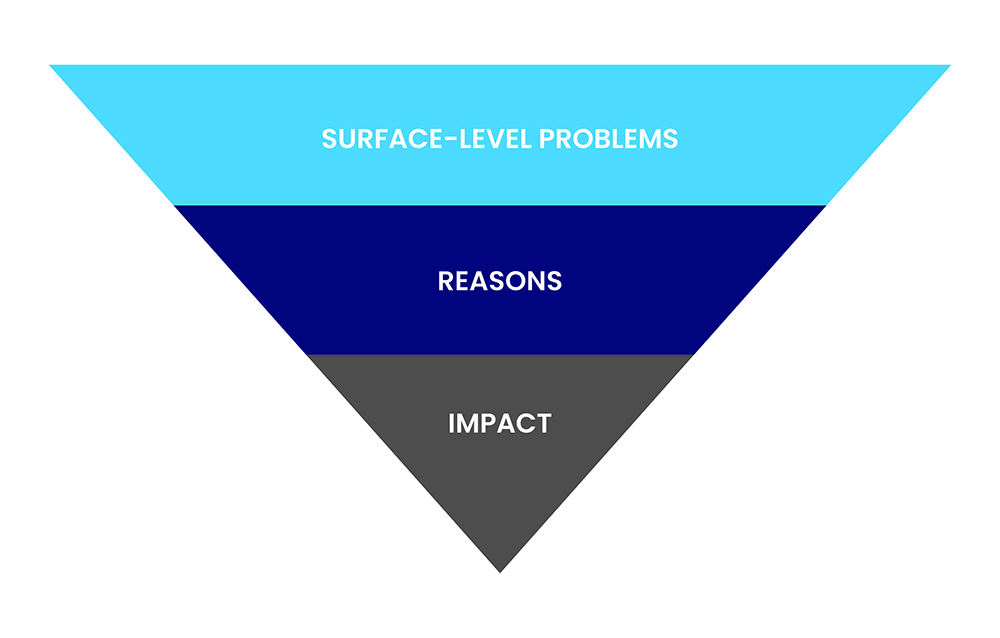
“What kind of impact does that have?”
“How long has that been going on?”
“What happens if nothing changes?”
These simple questions aren’t magic words, but they become powerful when delivered with real person-to-person intention. When we ask them in that way, we’re inviting our prospect to get real. We’re helping them walk through the implications of staying stuck, right where they are.
The longer we can stay in that pain conversation—not rushing to rescue them, not offering solutions too early—the more committed they’ll be to finding a way out. That’s what we’re after.
Make It Emotional, Not Just Intellectual
A prospect saying, “Yeah, our process is inefficient,” is an intellectual statement. It’s not enough. We need to get them to the emotional layer. We can do that by asking: “Tell me about a time that inefficiency cost you something—what happened?” That’s how we get the real story, and it’s also how we get them to feel the experience again. That’s how urgency is born.
Silence is an important tool in uncovering emotional pain. Most reps, in my experience, can’t even wait a full second before jumping in. So my advice is always: Set yourself apart from the competition. Try three seconds. Four. Let them think. Let them feel. It’s uncomfortable, but it’s in that space of discomfort where the real answers start to surface. They’re not thinking about what you want to hear—they’re thinking about what’s actually true for them on an emotional level.
Your Product/Service Isn’t the Hero
It’s a mistake to try to make your product or service the hero of the story. The customer is the hero. They’re battling chaos, inefficiency, lost time, internal politics, whatever. Your job is simply to be the trusted guide—the one who understands what’s at stake, helps them name the dragon, and gives them the sword.
Once you learn to do that, you don’t need to win on features or price. You win by helping them connect the dots between their pain and the cost of inaction. You win by helping them see that not changing is actually riskier than changing.
Pain Drives the Buy
If you can help a buyer fully grasp the emotional and practical cost of their current situation—and tie your solution directly to the relief of that pain—you’ve built a case that’s not just logical, but deeply personal.
That’s what closes deals in real life. Not discounts. Not pressure tactics. Not mass emails. Not bullet points on a slide. None of that works. What works is empathy, insight, patience, and the courage to go deep.
So next time you walk into a sales conversation, forget about being impressive. Forget about selling. Be present. Be curious. Look for the pain. Listen until it hurts. And then—only then—offer a way out.
For more on helping your team members do a better job of uncovering emotional pain, drop us a line.


