


Four Ways for Sales Teams to Survive — and Thrive — During Times of Economic Uncertainty
In uncertain times—when leaders start issuing edicts to slash costs, suppliers get squeezed, and client loyalty becomes more fragile—strategic clarity becomes a competitive advantage for professional sellers. That’s true not just for the selling organization, but also for each individual member of a given sales team.
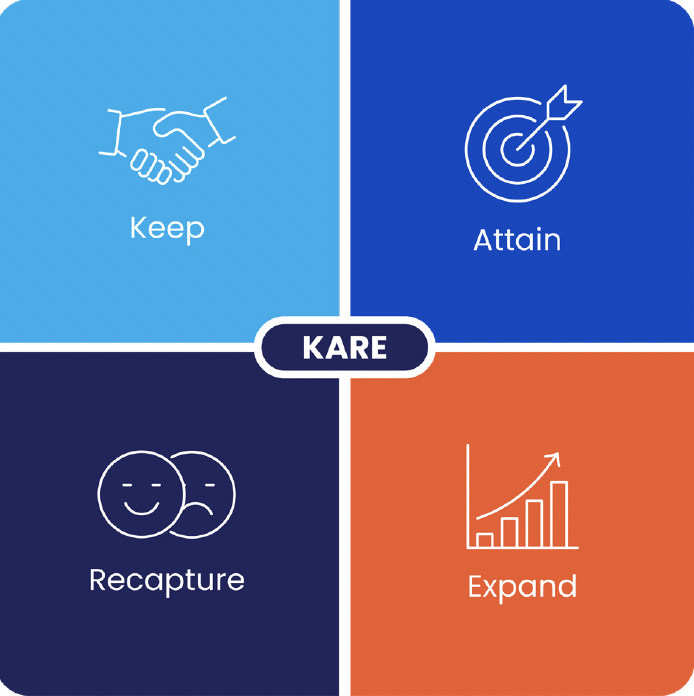
Enter Sandler’s KARE model: a simple, strategic four-quadrant framework that helps sales professionals focus their energy in the areas where doing so matters most. The acronym stands for Keep, Attain, Recapture, and Expand.
At first glance, KARE might seem almost too simple. But in practice, our clients have found that it’s a powerful way to segment your client and prospect base by strategic objective. This tool helps teams get organized at the company level, the division level, the regional level—and down to each individual salesperson.
Let’s look briefly at each corner of the quadrant.
KEEP: Lock Down Existing Clients
During economic downturns, protecting what you already have is priority number one. The “Keep” quadrant is about strategic defense. Clients you take for granted can—and will—get poached unless you strengthen and expand key business relationships … because organizations are under pressure, and senior decision makers are likely to send messages like “find a way to cut 5% across the board.” If you’re not proactively working to stay embedded in your clients’ world, someone else will be.
To safeguard your key accounts, you will probably want to consider:
- Widening your contact base. Don’t rely on one person—go deep and broad across silos.
- Shifting from check-in calls to strategic conversations. What are their priorities right now? What internal pressures are they facing?
- Reinforcing value at every touchpoint, reminding clients not just what you deliver, but why you’re irreplaceable.
- Meeting the threat head-on. If you know competitors will undercut you, make sure your client understands the true cost of switching—in terms of lost time, risk, uncertainty, or other factors.
This is the moment to make sure you are seen as the one supplier they can’t afford to lose – as opposed to another line item on the budget.
ATTAIN: Win Over New Prospects From Vulnerable Competitors
Economic upheaval doesn’t just create risk—it also creates openings. Companies that once had ironclad vendor relationships may now be questioning those choices. An executive who wouldn’t have taken your call last year might now be actively seeking alternatives. That’s where the “Attain” quadrant comes in.
Smart sales professionals know when to pivot their message by speaking to economic pain points like:
- Lower total cost of ownership
- Increased operational efficiency
- Risk diversification
- Business continuity
This is a good time to reach out to stakeholders you haven’t spoken to before (like CFOs and plant managers) who are likely to be driving new supplier conversations.
In this quadrant, you’re not just a vendor—you’re an opportunity. Position yourself that way, and some doors may open that were once locked tight.
RECAPTURE: Re-Engage Lost Accounts
If there’s a silver lining to COVID-era supply chain breakdowns and vendor switches, it’s this: many companies didn’t leave you by choice. They left because you couldn’t deliver in a given situation, or because they needed a stopgap solution. Now, with a few years of distance and a new set of pressures to face, they might just be ready to come back—if you make the first move.
Use the Recapture quadrant to:
- Revisit relationships lost during previous times of instability (like COVID, inflation spikes, and geopolitical disruptions).
- Reach out with humility and clarity: “We know what went wrong. Here’s how we’ve fixed it.”
- Ask one simple question: “Are you open to a conversation?”
In uncertain times, people often revert to the familiar. Make sure you’re one of the voices they remember.
EXPAND: Grow Inside Existing Accounts
While “Keep” is about defense, “Expand” is about offense—but inside the walls you’ve already breached. The focus here is on increasing wallet share, opening up new product lines, or winning over new divisions.
This is a quadrant of surgical strikes:
- Cross-sell into other departments.
- Upsell higher-volume orders.
- Replace dual-supplier models with sole-supplier strategies—if you can mitigate the risk.
A great example: A client gives 50% of their packaging business to you and 50% to a competitor for redundancy. In uncertain times, you make the case: “We’ve got six plants across the country. If there’s a disaster in one, we’ve got backup. Your other supplier only has one location, and it’s in a wildfire zone. Are you sure your 50/50 split still makes sense?”
Expansion becomes easier when you can position yourself not just as a supplier, but as a strategic hedge against disruption during uncertain times.
Simplicity Wins
Economic storms create complexity. During these storms, strategies get tangled; priorities shift. The brilliance of KARE as a tool for navigating stormy waters lies in is its radical simplicity. It helps you step back and ask four sharp, mission-critical questions:
- Who do I need to keep?
- Who could I attain?
- Who can I recapture?
- Where can I expand?
From there, you can build strategy, set goals, and create messaging tailored to each category. Some might say the model oversimplifies. But let’s face it: sometimes the simplest tool is the tool you need. KARE isn’t a strategy by itself; it’s a sorting mechanism, a way to ensure you’re not just reacting—but acting with intention.
If you, your team, or your organization find yourself heading into unpredictable economic waters, you may want to consider leading with protection by shifting your center of gravity to the “Keep” quadrant — and fortifying your base before venturing out to the other quadrants. Once you’ve locked those key clients down, you can begin expanding outward—recapturing what was lost, attaining what’s newly available, and growing deeper roots in the soil you’ve already tilled.
To learn more about the KARE model, which is part of the Sandler Enterprise Selling (SES) program, visit the SES web page — or drop us a line.
FAQs
- What is the KARE model?
The KARE model is a strategic framework designed for sales teams to focus their efforts effectively during economic uncertainty. It stands for Keep, Attain, Recapture, and Expand, helping sales professionals segment clients and prospects by strategic objectives.
- Why is the KARE model useful during economic downturns?
During economic downturns, clear strategic focus becomes a competitive advantage. The KARE model provides simplicity and clarity, allowing sales teams to prioritize actions that protect existing relationships while exploring new opportunities.
- How do I apply the ‘Keep’ quadrant in practice?
The ‘Keep’ quadrant focuses on protecting existing clients by strengthening relationships. Tactics include broadening contact bases within client organizations, shifting to strategic conversations, reinforcing your value, and addressing competitive threats directly.
- What strategies can be used to ‘Attain’ new prospects?
To ‘Attain’ new prospects, emphasize pain points such as lowering total costs, increasing efficiency, and ensuring business continuity. Engage with new stakeholders like CFOs and plant managers, positioning yourself as an opportunity during these uncertain times.
- How can I effectively ‘Recapture’ lost accounts?
The ‘Recapture’ quadrant involves revisiting lost accounts with humility and transparency about past issues. Re-establish connections by demonstrating how previous problems have been resolved and by simply asking if they’re open to a conversation.
- In what ways can I ‘Expand’ within existing accounts?
‘Expand’ by focusing on increasing wallet share through cross-selling, upselling, or consolidating supplier roles. Present yourself as a strategic partner who offers stability and risk mitigation, particularly during uncertain times.
- How does the KARE model help in setting sales strategies?
The KARE model simplifies the process of setting strategies by categorizing clients and prospects into four clear areas, allowing sales teams to tailor their approach to each, set specific goals, and create targeted messaging.
- Can the KARE model be applied to individual salespeople?
Yes, the KARE model is versatile and can be applied at various levels, from the company to individual salespeople, enabling personalized strategies that align with broader organizational goals.
- What should be the initial focus when implementing the KARE model?
Initially, focus on the ‘Keep’ quadrant to secure existing clients. By fortifying your base, you create a stable foundation from which to explore the other quadrants for growth opportunities.
- Is the KARE model adaptable to different industries?
Absolutely. The simplicity and strategic focus of the KARE model make it adaptable to various industries where maintaining and growing client relationships is crucial, especially during economic challenges.


